_edite.jpg)
The Critical Role of eCTD Expertise in Pharmaceutical Regulatory Submissions: Navigating a High-Demand, Low-Supply Frontier
- Dec 3, 2025
- 5 min read

In a pharmaceutical sector projected to exceed USD 1.7 trillion in 2025, the journey from laboratory discovery to patient delivery depends on a single, indispensable checkpoint: regulatory submission. Central to that process is the electronic Common Technical Document (eCTD)—a globally adopted standard now mandated by most major health authorities, including the FDA, EMA, and MHRA.
Yet as innovation in biologics, cell and gene therapies, RNA platforms and personalised medicines accelerates, a stark imbalance has emerged. The demand for skilled eCTD publishers and regulatory operations professionals has surged far beyond supply. What was once a specialised technical function has become a strategic bottleneck capable of delaying therapies, driving up R&D costs, and slowing patient access.
The Rising Stakes of Compliance
Every company developing a medicinal product—small molecule, biosimilar, ATMP, or combination therapy—must master eCTD submissions to secure regulatory approval. The consequences of failure are immediate and unforgiving. Technical rejections, often triggered by metadata inconsistencies or formatting errors, can prevent a submission from even entering scientific review.
FDA reports show thousands of sequences affected by validation issues in recent years, including 1,734 study-data–related errors between February 2022 and 2023—a pattern that has continued into 2025. Meanwhile, the EMA’s shift to validation v8.2 (mandatory from December 2025) underscores increasingly stringent compliance expectations. Post-Brexit regulatory divergence compounds the complexity, with the MHRA now requiring independent GB-specific sequences and UK-only labelling updates under the Windsor Framework.
Such hurdles are not trivial. A single month of delay in FDA review can cost a sponsor up to USD 10 million in lost revenue. For complex filings, compounded errors can introduce six to twelve months of setback—an erosion of market exclusivity and competitive advantage at a time when R&D costs exceed USD 100 billion annually across PhRMA members.
Why eCTD Capability Has Become Non-Negotiable
The global regulatory landscape in 2025 is defined by rapid expansion and rapid change. FDA approvals for novel drugs are at record highs, with nearly half involving innovative modalities such as immuno-oncology and rare-disease treatments. Each requires highly structured, impeccably validated eCTD submissions.
More than 8 million eCTD submissions have passed through the FDA since 2003, and by 2022, 94% of all filings were in eCTD format—a figure still climbing as mandates extend to legacy dossiers, variations and renewals.
Four major forces are fuelling the demand surge:
1. Mandatory transitions to eCTD 4.0
The FDA began voluntary acceptance of eCTD v4.0 in 2024, while the EMA launched technical pilots in 2025 ahead of a 2027 mandate. Conversion of over 100,000 existing dossiers is required by the decade’s end.New two-way messaging, granular metadata requirements, and controlled vocabularies strain legacy tools and demand specialist expertise.
2. Post-Brexit regulatory divergence
Since 2021, MHRA has required standalone GB submissions. The Windsor Framework adds new “UK-Only” requirements and parallel NI/GB sequence considerations—doubling the workload for companies marketing in both the EU and UK.
3. Increasing dossier complexity
Cell and gene therapies, RNA-based products, and hybrid drug–device combinations generate sprawling Module 3 CMC packages. Validation failures related to metadata mismatches have risen in 2025 EMA pilots. The rise of biosimilars and orphan drugs adds further strain.
4. Outsourcing as the new norm
The regulatory affairs market reached USD 10.14 billion in 2025, with 40–50% of submissions now outsourced. This is less a trend than a necessity: most companies simply cannot recruit or retain enough specialists.
A Global Talent Shortage With Local Consequences
Despite growing demand, the number of experienced eCTD publishers remains stubbornly limited. Tools such as LORENZ docuBridge, EXTEDO eCTDmanager, and Freyr platforms require deep technical expertise. Many senior specialists have retired or been absorbed by major pharmaceutical companies, leaving smaller firms struggling to fill critical gaps.
Leading service providers illustrate the scale mismatch:
Freyr employs 400+ publishing specialists, managing more than 200,000 submissions—yet still covering only a fraction of global need.
Celegence executes 2,500+ submissions annually with multi-level QC, while
Asphalion handles 1,500 sequences each year—but UK-specific MHRA expertise remains rare, with estimates suggesting fewer than 100 professionals able to manage FDA, EMA and MHRA submissions concurrently.
The result is predictable: talent shortages, soaring hiring costs (UK eCTD leads commonly command £150k+), and increasing reliance on external partners. These constraints have contributed to missed review deadlines and costly delays for sponsors across 2025.
ECTD Pharma: A Specialist Solution Born of Necessity
Against this backdrop, ECTD Pharma, founded in 2026 and based in the UK (ectdpharma.com), was created to address a widening gap: the acute need for dedicated, high-accuracy eCTD publishing in a post-Brexit regulatory environment.
Unlike generalist CROs, ECTD Pharma focuses exclusively on electronic submissions, combining advanced Freyr technology with deep regulatory operations experience across FDA, EMA, MHRA, Health Canada, Swissmedic, TGA, and GCC markets.
Its senior team has shaped industry best practice directly through involvement in ICH-aligned forums, and clients consistently report 100% first-pass validation—widely recognised as the gold standard.
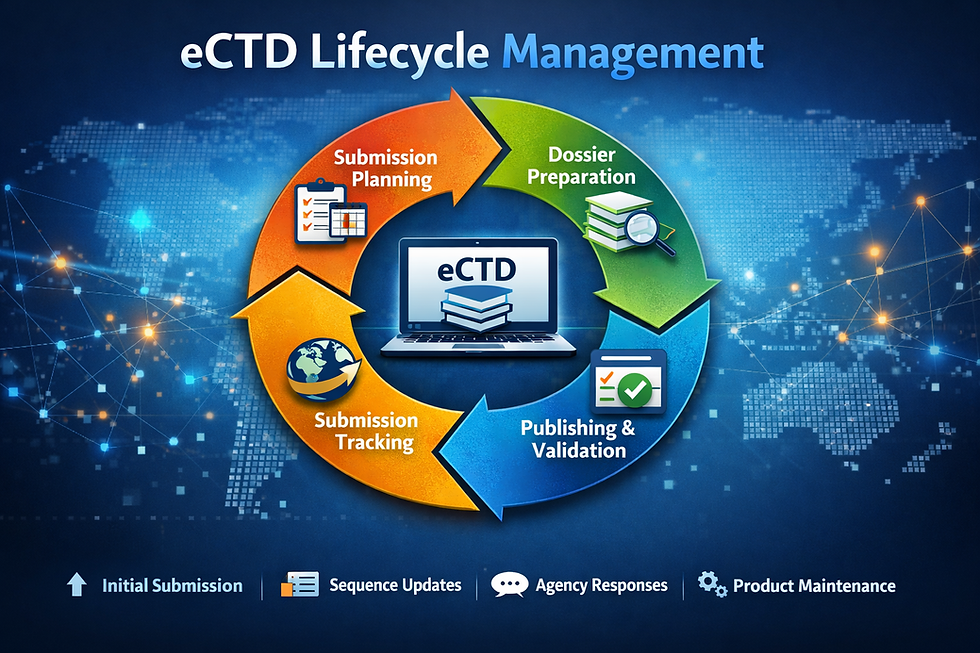
ECTD Pharma’s process follows a rigorous six-step model:
Consultation
Document Preparation
Dossier Compilation
Publishing & Validation
Submission
Lifecycle Management
This structure enables companies to meet tightening validation demands, including MHRA’s 2025 updates and the ongoing shift to eCTD v4.0.
End-to-End Support for a Complex 2025 Landscape
ECTD Pharma’s service portfolio spans the full regulatory ecosystem:
Complete eCTD publishing and global submissionsTurning raw documents into fully validated sequences for all major authorities.
MHRA-GB specialist submissionsExpertise in post-Brexit requirements, UK-only labelling, PLGB numbers, and Windsor Framework updates.
eCTD 4.0 and ISO-IDMP remediationPreparing legacy dossiers for new metadata-driven frameworks.
Complex Module 3 / CMC supportSpecialised handling of ATMPs, RNA therapeutics, and hybrid drug-device dossiers.
Regulatory operations outsourcing24/7 coverage to prevent overnight validation failures—a growing issue for global submissions.
Legacy conversions, IDMP readiness, training, and vendor selectionHelping organisations modernise systems and build internal competence.
Lifecycle management and archivingEnsuring sequence integrity and regulatory audit readiness.
The Measurable Advantage
The benefits are quantifiable. Avoiding even a single month of review delay can preserve millions in revenue and safeguard competitive positioning.ECTD Pharma’s clients report accelerated timelines, flawless compliance, and reductions in publishing time of up to 50%.
As eCTD v4.0 remediation accelerates through 2028, demand for expertise will only intensify. Companies that secure specialist capacity early—often during candidate selection—are best positioned to maintain uninterrupted development pipelines.
A Turning Point for Global Regulatory Strategy
In today’s regulatory climate, eCTD expertise is no longer a technical luxury; it is a strategic prerequisite for market access. With innovation accelerating and regulatory scrutiny tightening, flawless electronic submissions are now central to ensuring that new therapies reach patients without unnecessary delay.
For organisations seeking to strengthen their regulatory infrastructure, ECTD Pharma offers a powerful, specialist partner.To learn more, visit ectdpharma.com or email hello@ectdpharma.com.
ECTD Pharma: Empowering UK and global pharmaceutical innovation through precision-engineered electronic submissions.


Comments